

Fractional COO
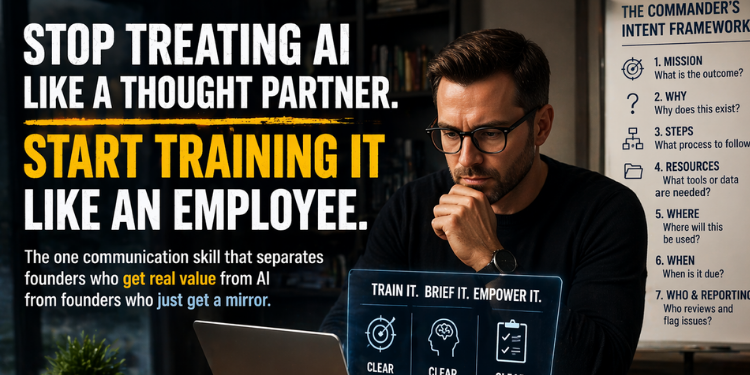

Most founders think AI is going to save their business. It won’t.
What AI actually does is expose how broken your business already is.
Right now, most companies are using AI as a thought partner.
What they actually built is a mirror.
It reflects:
And when you plug AI into that?
You don’t get leverage.
You get faster chaos.
This is not a technology issue.
This is an owner dependency problem.
If your business depends on you:
It will just scale the inefficiency.
Most founders in the $2M to $20M range are:
So when they “add AI,” what they actually do is create:
A faster version of themselves making the same fragmented decisions
That is not scale.
That is acceleration toward irrelevance.
There is a shift happening right now.
Not in five years. Not someday.
Right now.
Over the next 24 months, businesses will split into two categories:
1. AI-Integrated Operators
2. AI-Adjacent Talkers
The second group will not slowly fall behind.
They will become case studies.
This is where most people get it wrong.
They think the solution is:
It’s not.
The solution is how you think and communicate.
You must treat AI like a new employee.
Not metaphorically.
Operationally.
That means before you ask AI to do anything, you define:
What does success look like?
Why does this task exist?
What process should be followed?
What inputs are required?
Where will this be used?
What are the deadlines and dependencies?
Who reviews and approves the output?
When you do this, something shifts.
AI stops being a mirror.
It becomes a producer of usable work.
The founders who win with AI will not be the most technical.
They will be the most clear.
This is where most businesses fail.
They do not lack tools.
They lack structured thinking and communication.
The concept of Commander’s Intent solves this.
It forces you to define:
Without that, AI cannot operate effectively.
And neither can your team.
AI is not a plug-and-play solution.
It requires:
This is where most founders get stuck.
They try to:
All at the same time.
That is exactly why they stay the bottleneck.
A fractional COO:
A fractional CMO:
AI only works when:
Otherwise, it’s just expensive noise.
AI will not replace you.
But businesses that use AI correctly will replace those that don’t.
And the biggest risk is not that you ignore AI.
The biggest risk is:
You think you’re using it… but you’re not using it correctly.
That’s how businesses quietly fall behind.
This is not about learning AI.
This is about restructuring your business so AI can actually work.
If you:
You will not scale.
You will stall faster.
But if you:
You create leverage.
And leverage is what separates businesses that grow from businesses that disappear.
Want to see how you can leverage AI in your business? Click below to schedule a time to meet.

Treating AI like a thought partner instead of a structured execution tool. This creates a mirror effect instead of producing real business outputs.
By treating AI like a new hire. Define the mission, purpose, steps, resources, and accountability before assigning tasks.
Owner dependency occurs when the business cannot function or grow without the founder being directly involved in decisions and execution.
When properly implemented, AI handles repetitive tasks, supports decision-making, and integrates into workflows, reducing reliance on the owner.
It refers to the growing gap between businesses that integrate AI into operations now and those that delay adoption, risking long-term irrelevance.
In most cases, yes. AI requires operational structure and strategic alignment. Fractional leadership provides this without the cost of full-time executives.